

The Language Precision Framework: Your Guide to Clearer Conversations at Work
The Language Precision Framework is a set of language patterns that help managers identify vague communication and recover deleted information through precision questions. When employees say "Nobody listens" or "This won't work," they're using generalizations and deletions that hide critical specifics. The Language Precision Framework teaches managers how to ask targeted questions that transform vague complaints into actionable information, creating the clarity that drives results.
The $420,000 Problem Hidden in Vague Language
A manager in a Bellevue tech company tells their team: "We need better communication."
Everyone nods. The meeting ends. Nothing changes.
Why? Because "better communication" means something different to every person in that room. One person thinks it means more frequent updates. Another interprets it as more honesty. A third assumes it means clearer written documentation.
Vague language creates vague results.
Research shows that small and mid-sized companies lose an average of$420,000 annually due to poor communication (SHRM). Much of that loss stems from unclear instructions, misunderstood expectations, and assumptions that go unchecked.
The Language Precision Framework provides a linguistic framework for recovering the specificity that vague language leaves unclear.
What Is the Language Precision Framework?
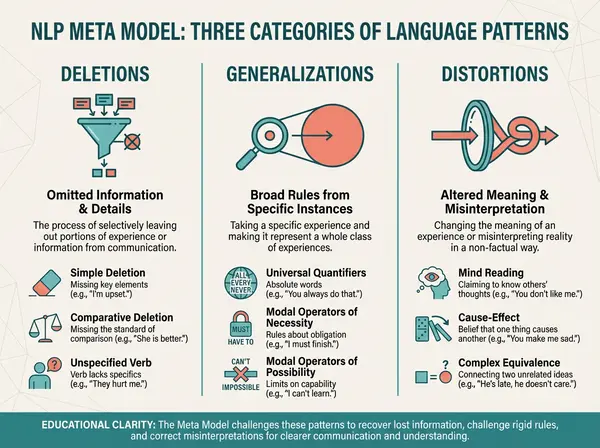
The Language Precision Framework helps us recover missing information, challenge overgeneralizations, and test distorted meaning, both as a speaker and as a listener. When language and meaning are vague, we learn to ask "what's missing, assumed, or distorted in the statement" rather than rely on the "fill in the blank" mode our mind defaults to absent specific information.
The Three Categories:
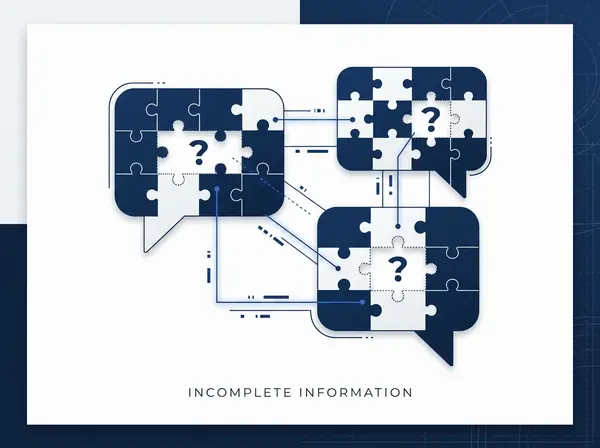
1. Deletions- Information left out, usually unconsciously.
2. Distortions- Meaning is added by the speaker or listener, often inaccurately. The mind creates connections and assumptions that may not be true.
3. Generalizations- When the mind takes one or a few experiences and turns them into rules. This is the brain's attempt to create certainty and predictability, but it often is wrong or overreaches.
Each category contains specific patterns, and each pattern has corresponding precision questions that recover the missing information.
Think of the Language Precision Framework as a decoder ring for workplace communication. It helps you translate vague statements into actionable specifics.
Language Precision Framework Patterns (With Real Examples)
DELETIONS (Missing Information)
Pattern 1: Simple Deletion
Example: "I'm frustrated."
What's missing: The specific cause, target, or context of the frustration is omitted.
Recovery question: "Frustrated about what specifically?"
Pattern 2: Comparative Deletion
Example: "This is better."
What's missing: The comparison standard and criteria are missing.
Recovery question :"Better than what specifically? Better in what way?"
Pattern 3: Unspecified Referential Index
Example: "They don't respect me."
What's missing: The identity of the people being referred to is unclear.
Recovery question: "Who specifically doesn't respect you?"
Pattern 4: Unspecified Verb
Example: "He rejected my idea."
What's missing: The specific behavior or action that counts as "rejected" is not defined.
Recovery question: "How specifically did he reject it? What did he say or do?"
GENERALIZATIONS
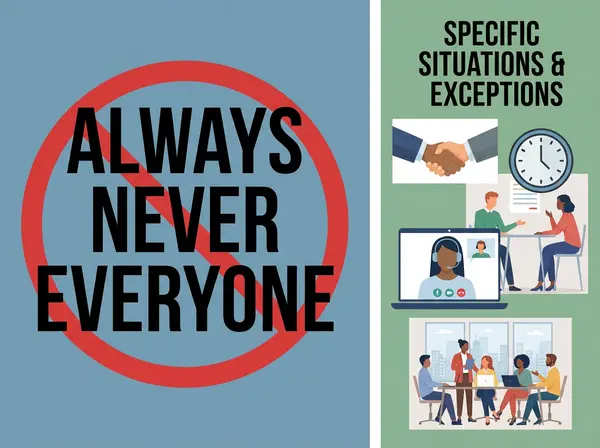
Pattern 5: Universal Quantifiers
Example: "You never listen to me."
What's missing: Exceptions are deleted, and a limited set of experiences is being treated as universal.
Recovery question: "Never? Can you think of a time when I did listen?"
Pattern 6: Modal Operators of Necessity
Example: "I have to finish this tonight."
What's missing: The consequence, rule, or perceived necessity behind the statement is left unexamined.
Recovery question: "What would happen if you didn't finish it tonight?"
Pattern 7: Modal Operators of Possibility
What they are: Words that magnify limiting beliefs
Example: "I can't give that presentation."
What's missing: The specific obstacle, limit, or condition preventing action is unspecified.
Recovery question: "What prevents you from giving the presentation?"
DISTORTIONS
Pattern 8: Nominalization
Example: "There's no communication here."
What's distorted: An ongoing process is being turned into a static thing, which hides who is doing what to whom.
Recovery question: "Who specifically isn't communicating with whom about what?"
Pattern 9: Mind Reading
Example: "You think I'm incompetent."
What's distorted: A conclusion about another person's internal thoughts is presented without observable evidence.
Recovery question: "How do you know that's what I think? What specifically makes you believe that?"
Pattern 10: Cause-Effect
Example: "You make me so angry."
What's distorted: A direct causal link is assumed between another person's behavior and the speaker's emotional state.
Recovery question: "How specifically does what I do cause you to feel angry?"
Pattern 11: Complex Equivalence
Example:"He didn't say hello, so he doesn't like me."
What's distorted:Two different experiences are being treated as if they mean the same thing.
Recovery question:"How does not saying hello mean he doesn't like you?"
Pattern 12: Presupposition
Example: "When are you going to stop being so defensive?"
What's presupposed: The sentence assumes as fact that the person is being defensive.
Recovery question: "What specifically am I doing that seems defensive to you?"
Pattern 13: Lost Performative
Example: "That was unprofessional."
What's distorted: A value judgment is stated without identifying whose standard is being used.
Recovery question: "According to whom? By what standard?"
Top 10 Language Precision Framework Questions Every Manager Needs
Memorize these, they work in 90% of workplace situations:
"Specifically?"- Universal recovery question for almost any vagueness
"Who/what specifically?"- Identifies deleted specifics
"How specifically?"- Recovers process information
"Compared to what?"- Challenges comparative deletions
"Always/never/everyone?"- Challenges universal quantifiers
"What would happen if you did/didn't?"- Explores modal operators
"How do you know?"- Challenges mind-reading
"Who is [verbing] whom?"- Denominalizes abstract nouns
"What prevents you?"- Identifies real vs. imagined obstacles
"Can you give me a specific example?"- Moves from abstract to concrete
Language Precision Framework in Action: 5 Common Workplace Scenarios

Scenario 1: The Vague Complaint
Employee: "This project is a disaster."
Without Language Precision Framework: "I'm sorry you feel that way. Let's try to fix it."
With Language Precision Framework:
"What specifically about the project is a disaster?"
"How specifically is it a disaster?"
"Compared to what?"
"What would need to change for it not to be a disaster?"
Result: You move from emotional venting to specific, solvable problems.
Scenario 2: The Limiting Belief
Employee: "I can't do public speaking."
Without Language Precision Framework: "That's okay, we'll find someone else."
With Language Precision Framework:
"What specifically prevents you from public speaking?"
"What would happen if you did?"
"Have you ever spoken to a group successfully, even a small one?"
Result: You help them challenge the belief and identify specific fears to address. This is so helpful for employees! This gets them to think about what their beliefs and fears actually are instead of making this vague, blanket statement.
Scenario 3: The Mind Reader
Employee: "You don't trust me with important work."
Without Language Precision Framework: "That's not true!" (Defensive response)
With Language Precision Framework:
"What specifically have I done that makes you think I don't trust you?"
"How do you know that's what I think?"
"What would I do differently if I did trust you?"
Result: You surface the specific behaviors that created the interpretation, and can address them.
Scenario 4: The Generalization
Employee: "Nobody ever tells me anything."
Without Language Precision Framework: "I'll make sure to keep you informed." (Vague promise)
With Language Precision Framework:
"Nobody? Who specifically isn't telling you what?"
"What specifically do you need to know that you're not hearing?"
"When did someone tell you something important? What made that effective?"
Result: You identify specific information gaps rather than committing to flooding them with everything.
Scenario 5: The Nominalization
Employee: "We have a failure of leadership here."
Without Language Precision Framework:(Taking it personally or getting defensive)
With Language Precision Framework:
"Who specifically is failing to lead whom?"
"How specifically should someone be leading differently?"
"What does effective leadership look like to you?"
Result: You transform an abstract accusation into actionable feedback.
The 8 Rules for Using Language Precision Framework Effectively
Rule 1: Use a Curious Tone, Not an Interrogative One
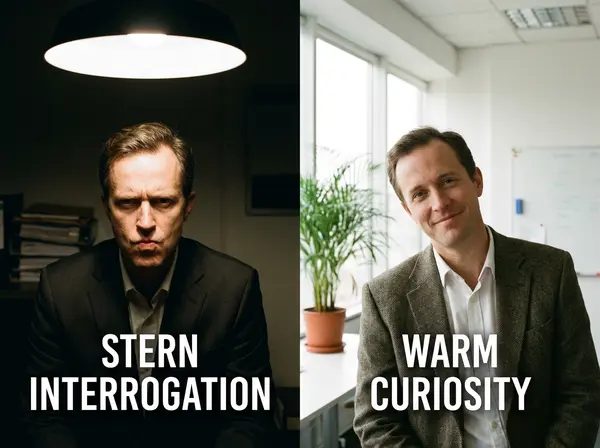
The same question can sound supportive or attacking depending on tone:
Interrogative: "WHO specifically?" (implies "Tell me how it is!")
Curious: "Who specifically?" (implies "Help me understand fully")
Rule 2: Build Rapport First
If someone doesn't feel safe with you, Language Precision Framework questions could feel like attacks. Establish trust before precision questioning.
Rule 3: Match Their Energy
If they're emotional, acknowledge the emotion before seeking specifics:
"I can see you're really frustrated. Help me understand specifically what's happening..."
Rule 4: Don't Use All 13 Patterns in One Conversation
You're seeking clarity, not conducting a deposition. Choose 2-3 most important patterns to address.
Rule 5: Explain Why You're Asking
"I want to make sure I fully understand so I can actually help. Can you tell me specifically..."
Rule 6: Know When to Stop
If someone is getting more frustrated or shutting down, you've pushed too far. Back off and acknowledge emotions.
Rule 7: Practice on Yourself First
Notice your own vague language. Before asking your team for specificity, start making your own communication more precise.
Rule 8: Combine with State Management
Your state matters more than your questions. Come from genuine curiosity, not judgment.
Common Language Precision Framework Mistakes (And Corrections)
Mistake 1: Sounding Like a Therapist
Wrong: "Interesting. And how does that make you feel?"
Better: "Got it. What specifically needs to change?"
Mistake 2: Over-Using the Model
Wrong: Questioning every single statement
Better: Focus on statements that block progress or create confusion
Mistake 3: Forgetting the Goal
Wrong: Getting lost in linguistic precision for its own sake
Better: Use precision to create clarity that enables action
Mistake 4: Using It to "Catch" People
Wrong: "Aha! That's a universal quantifier! You said 'always'!"
Better: Naturally ask, "Always? Help me understand when this happens most."
The Specificity Spectrum: From Vague to Precise
Most workplace communication exists on a spectrum:
Level 1: Maximally Vague
"Things aren't working."
"We need to do better."
"There's a problem with communication."
Level 2: Somewhat Vague
"The sales process isn't working."
"Our meetings need to be more productive."
"Communication between departments is unclear."
Level 3: Moderately Specific
"Our sales process takes too long between initial contact and close."
"Our meetings run 30 minutes over and don't produce clear action items."
"Engineering and Marketing don't understand each other's timelines."
Level 4: Maximally Specific
"Our average sales cycle is 90 days, and competitors close in 45. We need to identify which stage creates the delay."
"Yesterday's meeting ran from 10am-11:30am without producing assigned owners or deadlines for the Q2 launch tasks."
"Engineering commits to 2-week sprints while Marketing expects same-day asset changes, creating conflict when timelines don't align."
Your job as a leader: Move every important conversation from Level 1-2 to Level 3-4.
Language Precision Framework Practice Exercises for Managers
Exercise 1: The Daily Decoder (5 minutes/day)
Listen for one Language Precision Framework pattern in meetings or emails. Note it in your journal. Ask yourself: "What precision question would recover the missing information?"
Exercise 2: The Email Challenge
Before sending your next team email, read it specifically looking for:
Unspecified referential index ("they," "it," "this")
Nominalizations (abstract nouns)
Unspecified verbs
Rewrite for clarity.
Exercise 3: The One-on-One Deep Dive
In your next 1:1, practice asking Language Precision Framework questions for just 10 minutes. Notice:
What new information emerges?
How does the conversation change?
What becomes possible that wasn't before?
Exercise 4: The Self-Audit
Record yourself leading a meeting. Listen back and count your own vague language. Commit to reducing one pattern per week.
Building a Culture of Precision
When leaders consistently model specific communication:
✅Teams ask better questions(they learn by watching you)
✅Problems get solved faster(less time wasted in vagueness)
✅Accountability increases(specific commitments are easier to track)
✅Trust deepens(clarity eliminates suspicion that forms in ambiguity)
✅Conflict decreases(most conflict lives in the gap between unclear expectations)
Companies throughout Seattle, Bellevue, and Bellingham that adopt Language Precision Framework communication report measurably faster decision-making and fewer "I thought you meant..." conflicts.
Your Language Precision Framework Implementation Plan
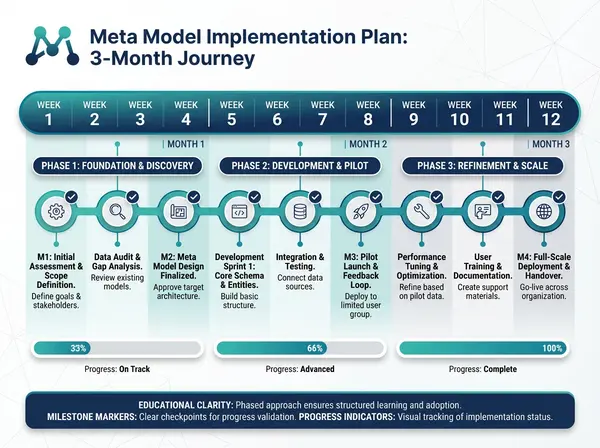
Week 1: Awareness
Read this article twice
Listen for patterns in your own speech
Don't intervene yet, just notice
Weeks 2-3: One Pattern
Choose one pattern (start with unspecified referential index or universal quantifiers)
Practice asking the corresponding recovery question 3×/day
Notice what shifts
Month 2: Integration
Add 2-3 more patterns
Practice in low-stakes conversations first
Gradually use in important discussions
Month 3: Team Training
Teach your team the top 5 patterns
Make "Can you be more specific?" a team norm
Celebrate when people self-correct vague language
Ongoing: Mastery
Language Precision Framework becomes unconscious competence
Precision is your default communication style
Others describe you as exceptionally clear
About the Author
Barbara Jenks is a Strategic Leadership Communication Coach specializing in neuro, cognitive, and behavioral science, neuroscience, and improv techniques. She teaches managers in the Greater Puget Sound Region how to transform vague language into actionable clarity.
With over 20 years of HR leadership experience at Fortune 500 companies including Boeing and Fox, Barbara has mediated hundreds of workplace conflicts and trained thousands of leaders. She holds an Advanced Collective Bargaining Studies Certificate in Labor Relations from Cornell University and is the co-author of Choose Confidence: The Decision to Embrace Your Power.
Barbara combines proven techniques from neuroscience and improv to help overwhelmed managers become confident communicators who build high-trust, high-performance teams.
Connect with Barbara:
📧 Email: [email protected]
🌐 Website:www.clearlycommunicate.com
💼 LinkedIn: linkedin.com/in/barbarajenks
FAQ SECTION
Q 1: What is the Language Precision Framework and why do managers need it?
The Language Precision Framework is a linguistic framework developed by Richard Bandler and John Grinder that helps managers identify and correct vague language patterns through precision questioning. Managers need it because vague communication costs small and mid-sized companies an average of $420,000 annually (SHRM). When employees use generalizations like "Nobody listens" or deletions like "This won't work," critical information is hidden. The Language Precision Framework provides specific questions to recover deleted information, challenge overgeneralizations, and test distorted meanings, transforming vague complaints into actionable clarity that drives measurable results.
Q 2: What are the three main categories of Language Precision Framework patterns?
The Language Precision Framework identifies three categories of linguistic patterns:
(1)Deletions- information left out unconsciously, like "I'm frustrated" (missing what specifically causes frustration);
(2)Generalizations- when the mind takes limited experiences and creates universal rules, like "You never listen" (deleting exceptions); and
(3)Distortions- when meaning is added inaccurately, like "He didn't say hello, so he doesn't like me" (assuming two unrelated events mean the same thing). Each category contains 4-5 specific patterns with corresponding precision questions to recover missing information.
Q 3: What are the top Language Precision Framework questions managers should memorize?
The top 10 Language Precision Framework questions that work in 90% of workplace situations are:
(1) "Specifically?" - universal recovery for vagueness;
(2) "Who/what specifically?" - identifies deleted details;
(3) "How specifically?" - recovers process information;
(4) "Compared to what?" - challenges comparative deletions;
(5) "Always/never/everyone?" - challenges universal quantifiers;
(6) "What would happen if you did/didn't?" - explores modal operators;
(7) "How do you know?" - challenges mind-reading;
(8) "Who is [verbing] whom?" - denominalizes abstract nouns;
(9) "What prevents you?" - identifies obstacles;
(10) "Can you give me a specific example?" - moves from abstract to concrete.
Q 4: How do you use Language Precision Framework questions without sounding like an interrogator?
Use Language Precision Framework questions effectively by following these guidelines: (1) Use a curious tone, not interrogative - "Who specifically?" (curious) vs. "WHO specifically?" (attacking); (2)Build rapport first- establish trust before precision questioning; (3)Match their energy- acknowledge emotions before seeking specifics: "I can see you're frustrated. Help me understand what specifically..."; (4)Explain why you're asking- "I want to make sure I fully understand so I can help..."; (5)Don't overuse- choose 2-3 most important patterns per conversation, not all 13; (6)Know when to stop- if they're shutting down, acknowledge emotions and back off.
Q 5: What is a nominalization and how do you address it in the workplace?
A nominalization is when an ongoing process (verb) is turned into a static thing (noun), hiding who is doing what to whom. Examples include "There's no communication here" or "We have a failure of leadership." To address nominalizations, ask recovery questions that convert the noun back to a verb: "Who specifically isn't communicating with whom about what?" or "Who specifically is failing to lead whom, and how specifically should they lead differently?" This transforms abstract accusations into actionable feedback. Bellevue and Tacoma managers report that denominalizing vague complaints reduces defensiveness and surfaces specific, solvable problems.
Q 6: How does the Language Precision Framework help with employee limiting beliefs?
The Language Precision Framework challenges limiting beliefs by identifying modal operators (can't, must, should, have to) and exploring what's really preventing action. When an employee says "I can't do public speaking," ask: (1) "What specifically prevents you from public speaking?"; (2) "What would happen if you did?"; and (3) "Have you ever spoken to a group successfully, even a small one?" These questions help employees examine whether the limitation is real or imagined, surface specific fears, and identify exceptions that prove the belief isn't universal. This empowers employees to think critically about their beliefs instead of accepting vague, blanket statements as truth.
Q 7: What's the difference between interrogative and curious Language Precision Framework questioning?
The difference lies entirely in tone and intention.
Interrogative questioning feels like an attack: "WHO specifically?" with sharp emphasis implies "Prove it!" or demands justification.
Curious questioning invites collaboration: "Who specifically?" with genuine interest implies "Help me understand fully so I can support you." Build rapport before asking precision questions, match the other person's emotional energy, acknowledge feelings first ("I can see you're frustrated..."), and explain why you're asking ("I want to make sure I understand so I can actually help"). managers who master curious tone report employees feel supported rather than interrogated.
Q 8: How long does it take to implement Language Precision Framework communication in your team?
A phased implementation typically takes 3 months to establish as a team norm:
Week 1- Awareness phase: leaders read materials, listen for patterns in their own speech without intervening.
Weeks 2-3- Practice one pattern: choose unspecified referential index or universal quantifiers, ask recovery questions 3×/day in low-stakes conversations.
Month 2- Integration: add 2-3 more patterns, gradually use in important discussions.
Month 3- Team training: teach the top 5 patterns, make "Can you be more specific?" a team norm, celebrate self-correction.
Ongoing- Language Precision Framework becomes unconscious competence; precision becomes default style. Bellevue tech companies report measurably faster decision-making and fewer "I thought you meant..." conflicts after 90 days.
