

Beyond Active Listening: How to Hear What Your Employees Aren't Saying
Strategic listening goes beyond parroting back what someone said. It’s hearing the need behind the words. While active listening focuses on demonstrating that you heard correctly, strategic listening uncovers what isn't being said: the fears, desires, and unmet needs driving behavior. This novel, neuroscience-based approach transforms how managers in the northern and greater Puget Sound region handle complaints, resistance, and conflict. When you master strategic listening, employees feel genuinely understood, and trust deepens, problems surface earlier, and solutions emerge organically.
Why Active Listening Isn't Enough
You've been trained in active listening. You know the drill:
Maintain eye contact
Nod occasionally
Paraphrase what you heard: "So what I'm hearing is..."
Ask clarifying questions
And yet, your employee walks away feeling like you didn't really get it. The issue resurfaces. The frustration builds. The disconnect widens.
Here's why: Active listening focuses on the content of what's said. Strategic listening focuses on the meaning and need behind what's said.
According to research from the International Listening Association, most people only retain 25-50% of what they hear in conversations. But the bigger problem isn't retention. It's that we're listening to the wrong layer.
When an employee in Seattle or Everett says, "I can't get anything done with all these meetings," active listening responds: "Sounds like you're feeling overwhelmed by the number of meetings."
A strategic listener wonders: "What need isn't being met? What are they really saying?"
Possible underlying needs:
Autonomy: "I need control over my schedule"
Clarity: "I don't understand how my work connects to these discussions"
Competence: "I'm afraid I'm not performing well enough"
Connection: "I feel disconnected from the team's purpose"
The same sentence can have entirely different meanings depending on the person and context. Strategic listening decodes the real message.
The Three Layers of Communication
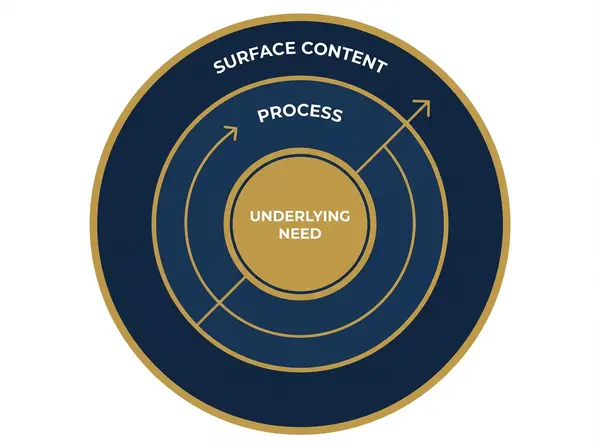
Every statement operates on three levels:
Layer 1: Surface Content (What They Say)
The literal words spoken: "I can't work with Sarah."
Layer 2: Process (How They Say It)
Tone, body language, energy, word choice: Tight voice, crossed arms, frustrated expression.
Layer 3: Underlying Need (What They Really Mean)
The deeper need or fear: "I feel disrespected" / "I'm afraid of being blamed" / "I need to be heard."
Most managers in Bellevue and Bellingham respond only to Layer 1. They try to fix the surface problem by switching teams, mediating a single interaction, offering conflict resolution training.
But if the underlying need remains unaddressed, the problem morphs and resurfaces.
Strategic listening operates at all three layers simultaneously.
The Communication Filtering Model: How Messages Get Distorted
Understanding how people create their internal reality is essential to strategic listening.
The Communication Filtering Model shows that information flows through these stages:
1. External Event → Something happens in the world
2. Sensory Input → Information enters through five senses (Visual, Auditory, Kinesthetic, Olfactory, Gustatory)
3. Internal Filters → The brain processes input through:
Deletions: Leaving out information
Distortions: Changing the meaning
Generalizations: Applying patterns broadly
4. Internal Representation → The person's unique "map" of reality
5. State → Emotional and physiological response to the original input
6. Physiology → Body language and behavior that results from this process
7. Response → What they say and do after having gone through this process
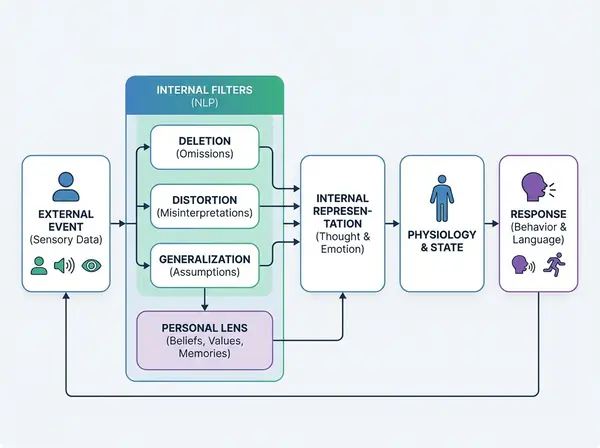
Research from cognitive psychology shows that we delete, distort, or generalize approximately 99% of available information to manage cognitive load Miller, Magical Number Seven because the human mind receives roughly 11 million bits of information per second from the senses (primarily visual and auditory) during communication. However, the conscious mind is limited to processing only about 50 bits per second. https://www.britannica.com/science/information-theory/Physiology This means when your employee says something, they're giving you a heavily filtered version of their experience, not the complete picture.
Strategic listening reverses the process. You work backward from what they said to understand their internal representation and unmet needs.
The 5 Strategic Listening Skills
Skill 1: Listen for Language Patterns (Not Just Content)
Pay attention to:
Nominalizations (verbs turned into abstract nouns):
"There's no communication here" (Who isn't communicating with whom?)
"Our relationship is broken" (How specifically are you relating?)
Generalizations:
"You always..." / "You never..." (Always? Can you think of one exception?)
"Everyone thinks..." (Everyone? Who specifically?)
Unspecified Referential Index:
"They don't respect me" (Who specifically doesn't respect you?)
"This isn't working" (What specifically isn't working?)
Modal Operators of Necessity/Possibility:
"I have to..." / "I should..." / "I must..." (What would happen if you didn't?)
"I can't..." (What prevents you?)
When you hear these patterns, you know critical information has been deleted. Your job is to recover it through precision questions.
Skill 2: Listen for Emotional Subtext
Words carry emotional data that reveal needs:
Fear-based language signals need for safety/security:
"What if..." / "I'm worried that..." / "I'm afraid..."
Underlying need: Security, predictability, control
Frustration-based language signals blocked goals:
"This always happens" / "Nothing ever changes" / "I've tried everything"
Underlying need: Progress, effectiveness, agency, safety
Resignation-based language signals loss of hope:
"It doesn't matter" / "Whatever" / "I guess"
Underlying need: Mattering, significance, impact
Defensive language signals threatened identity:
"That's not fair" / "You don't understand" / "I didn't..."
Underlying need: Respect, fairness, being seen accurately
Managers in Lynden and Everett who tune into emotional subtext can address root causes instead of surface symptoms.
Skill 3: Listen to Body Language and Congruence
Words lie. Bodies don't.
Incongruence signals (words don't match body):
Says "I'm fine" while crossing arms and avoiding eye contact
Says "I'm excited about this" in a flat, monotone voice
Says "I understand" while looking confused
When you notice incongruence, believe the body, not the words. The body reveals the truth.
Strategic listening response: "I notice you said you're fine, but your body language suggests something's bothering you. What's really going on?"
Research from UCLA shows that when communication is incongruent, people focus on body language and tone: 55% of communication impact comes from body language, 38% from tone, and only 7% from words [Mehrabian, Silent Messages]. Yet most managers focus exclusively on the 7%.
Skill 4: Listen for What's Missing
Often the most important information is what's not said:
The topic they avoid
The person they don't mention
The solution they don't propose
The question they don't ask
The emotion they don't express
Example:
Employee says: "The project timeline is too aggressive. We need more resources and clearer requirements."
What's missing: Any mention of their own role or contribution. No "I" statements.
Strategic listening insight: They may be avoiding ownership or feeling incompetent and afraid to admit it.
Strategic response: "I hear your concerns about timeline and resources. I'm also curious, how do you see your role in navigating these constraints?"
This invites them to step into ownership rather than staying in victim mode.
Skill 5: Listen to the Need Behind the Complaint
Every complaint points to a violated value or unmet need:
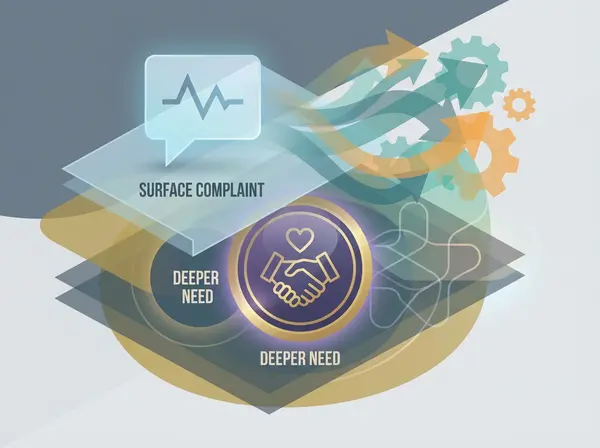
When you identify the need, you can address it directly:
Surface response: "I'll make sure to CC you on emails going forward."
Strategic response: "It sounds like you're not feeling included in important decisions. Help me understand: what level of involvement would help you feel like a valued part of this team?"
The second response addresses the need (inclusion, mattering), not just the symptom (information sharing).
Top 6 Strategic Listening Questions That Change Everything
These questions help you move from surface content to underlying needs:
1. "What does [that situation] mean to you?"
Reveals their interpretation and values
Example: "What does 'being micromanaged' mean to you specifically?"
2. "What would [desired outcome] give you?"
Uncovers the need beneath the request
Example: "If you had more autonomy, what would that give you?"
3. "What prevents you from [taking action]?"
Identifies limiting beliefs or real obstacles
Example: "What prevents you from speaking up in meetings?"
4. "How do you know [assumption/belief]?"
Challenges mind-reading and assumptions
Example: "How do you know that I don't value your input?"
5. "What specifically about [situation] bothers you?"
Moves from vague complaint to specific issue
Example: "What specifically about the feedback process isn't working for you?"
6. "If you could have it any way you wanted, what would that look like?"
Opens possibility and engages creative thinking
Example: "If you could design the ideal team structure, what would it look like?"
These questions aren't interrogations but invitations to clarity. Tone matters enormously. Ask with genuine curiosity, not judgment.
The 7 Deadly Listening Mistakes (And How to Change Them)
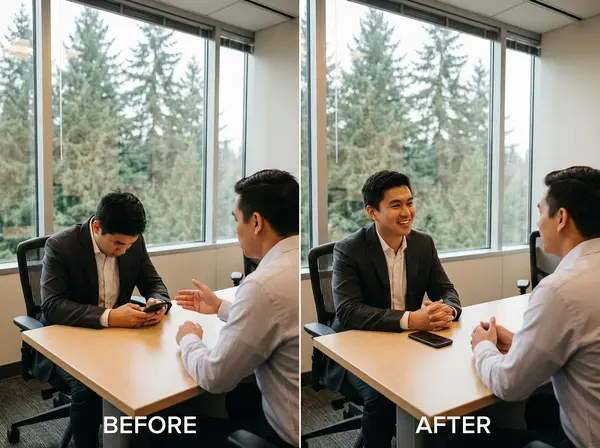
Mistake 1: Planning Your Response While They're Still Talking
You're not listening, you're rehearsing. The other person senses it.
Fix: Practice "holding space." Tell yourself: "My only job right now is to fully understand their experience."
Mistake 2: Listening to Fix, Not to Understand
You interrupt with solutions before they've fully expressed themselves.
Fix: Say, "Help me understand completely before we explore solutions." Let them finish.
Mistake 3: Making It About You
"That reminds me of when I..." and you've hijacked the conversation.
Fix: Resist the urge to share your own story. Stay focused on their experience.
Mistake 4: Judging While Listening
Your internal dialogue: "That's ridiculous" / "They're being too sensitive" / "Here we go again..." This internal conversation is showing on your face and in your body language, and will sabotage the conversation.
Fix: Practice the underlying assumption: "Everyone's behavior makes sense from their map of the world." Seek to understand and ask questions about their map.
Mistake 5: Listening Only for What Confirms Your Beliefs
Confirmation bias: You hear what supports your existing opinion and miss contradictory information.
Fix: Actively listen for information that surprises you or challenges your assumptions.
Mistake 6: Taking Everything at Face Value
Accepting "I'm fine" when every signal says they're not.
Fix: Learn to notice and gently name incongruence. "Your words say one thing, but I'm sensing something else."
Mistake 7: Listening Without Your Body
You're physically present but energetically absent by checking email mentally, thinking about other tasks.
Fix: Before important conversations, take 30 seconds to center yourself. Set an intention: "I'm going to be fully present."
Managers throughout Bellingham and Seattle report that fixing even one of these mistakes transforms their relationships.
Strategic Listening in Action: Three Real Scenarios
Scenario 1: The Chronic Complainer
Employee says: "Nothing ever changes around here. We have the same problems month after month and leadership doesn't care."
Active listening response: "You're frustrated that problems aren't being addressed."
Strategic listening response:
Notice the pattern: Generalizations ("nothing," "ever," "same"), external blame ("leadership doesn't care"), victim stance (no ownership).
Listen for the need: Agency, impact, being heard.
Strategic response: "I hear your frustration. Tell me specifically, what's one problem you've personally tried to solve, what did you try, and what got in the way?"
This shifts them from victim to agent and gets specific information you can work with.
Scenario 2: The Silent Struggler
Employee says: "Everything's fine. The project is on track."
Active listening response: "Great, glad to hear it."
Strategic listening response:
Notice what's missing: No details, no emotion, closed body language, quick dismissal.
Listen for the need: Possibly safety, fear of judgment, perfectionism.
Strategic response: "I appreciate the update. I'm also noticing you seem a bit [tired/stressed/withdrawn]. Is there something about this project that's harder than expected? I want to support you, not judge you."
This creates safety for honesty.
Scenario 3: The Resistor
Employee says: "I don't think this new process is going to work. We tried something similar two years ago and it failed."
Active listening response: "You have concerns based on past experience."
Strategic listening response:
Notice the pattern: Prediction stated as fact ("is going to"), past failure informing future expectation, deletion of differences.
Listen for the need: Competence, avoiding failure, being right.
Strategic response: "I value your historical perspective. Help me understand, what specifically failed last time, and what would need to be different this time for you to believe it could succeed?"
This honors their experience while opening possibility.
Building Your Strategic Listening Practice
Strategic listening is a skill that develops over time. Here's your progressive training plan:
Week 1-2: Pattern Recognition
Focus: Notice one language pattern per day (generalizations, deletions, or distortions)
Practice: In every conversation, identify at least one example
Journal: Write down what you noticed
Week 3-4: Body Language
Focus: Watch for congruence/incongruence between words and body
Practice: Silently note mismatches without commenting yet
Observe: How often do people say one thing but show another?
Week 5-6: Emotional Subtext
Focus: Listen for emotional themes (fear, frustration, resignation, defense)
Practice: Identify which emotion is present before responding
Experiment: Notice how your response changes when you address emotion
Week 7-8: Underlying Needs
Focus: Ask yourself, "What need might be driving this?"
Practice: For every complaint, identify 2-3 possible underlying needs
Test: Occasionally ask, "Is it possible you're needing ___?" and see if you're right
Month 3: Integration
Focus: Use all five strategic listening skills together
Practice: Have at least one deep listening conversation per day
Notice: How have your relationships shifted?
The Trust Multiplier Effect
When employees feel strategically listened to, something remarkable happens:
They bring problems to you earlier (because they trust you'll understand)
They stop repeating complaints (because they feel genuinely heard)
They take more ownership (because you've helped them see their agency)
They become more honest (because it's safe to be real)
They're more receptive to feedback (because the trust flows both ways)
Research from Google's Project Aristotle found that psychological safety, built primarily through quality listening, is the #1 predictor of team effectiveness Google re:Work.

Strategic listening creates that safety.
Strategic Listening and Cultural Intelligence in the Northern Puget Sound Region
The Northern Puget Sound region's diverse workforce requires cultural awareness in listening:
High-context communicators (many Asian cultures): Important information is implied, not stated directly. Listen for what's suggested, not just what's said explicitly.
Low-context communicators (many Western cultures): Direct communication is valued. Listen for literal meaning but still check for unstated concerns.
Indirect communicators: May soften concerns with "maybe," "perhaps," or questions rather than statements. "Don't you think we might want to consider...?" = "I have serious concerns."
Direct communicators: May seem blunt but value efficiency. Don't assume hostility, they're simply stating facts as they see them.
Managers working in diverse Seattle, Bellevue, and Tacoma workplaces benefit from adapting their listening style to match cultural communication norms while still seeking underlying needs.
Your Strategic Listening Challenge
This week, commit to one strategic listening conversation per day:
Choose someone you need to understand better
Set your state (calm, curious, open)
Set your intention ("My goal is to fully understand their perspective")
Use one strategic listening skill from this article
Notice what emerges that wouldn't have in a normal conversation
Journal the insight you gained
Over time, strategic listening becomes your default, and you become the leader people trust with their truth.
About the Author:
Barbara Jenks is a Strategic Leadership Communication Coach specializing in neuro, cognitive, and behavioral science, neuroscience, and improv techniques. With over 20 years of HR experience, she helps managers in the Puget Sound region hear what matters most.
Connect with Barbara at Clearly Communicate.
FAQ SECTION
Q1: What is the difference between active listening and strategic listening?
Active listening focuses on demonstrating you heard correctly by paraphrasing and clarifying content. Strategic listening goes deeper to uncover the needs, emotions, and underlying meanings behind what's said. Strategic listening asks "What do they really need?" rather than just "What did they say?"
Q2: How can managers in the Northern Puget Sound region improve listening skills?
Managers in Seattle, Bellevue, and Bellingham can improve listening through neuroscience-informed training that teaches pattern recognition, reading body language, identifying emotional subtext, and asking precision questions. Practice involves focusing on one skill at a time and gradually integrating all five strategic listening skills.
Q3: What are five strategic listening skills?
Five strategic listening skills are: (1) Listen for language patterns like generalizations and deletions, (2) Listen for emotional subtext, (3) Listen to body language and congruence, (4) Listen for what's missing or not said, and (5) Listen to the need behind the complaint.
Q4: How do you identify underlying needs in employee conversations?
Identify underlying needs by noticing language patterns, emotional tone, and what values might be violated. Common needs include autonomy, respect, clarity, competence, connection, and significance. Ask questions like "What would that give you?" or "What matters most to you about this?"
Q5: What is the communication filtering model?
The Communication Filtering Model shows how external events are filtered through our senses, then through deletions, distortions, and generalizations, creating an internal representation that triggers emotional states and behaviors. Understanding this model helps leaders decode what employees really mean.
Q6: Why is listening to body language important in leadership?
Body language accounts for 55% of communication impact. When words and body language don't match (incongruence), the body reveals the truth. Leaders who read body language can identify unspoken concerns, hidden emotions, and areas where employees need support.
Q7: How does strategic listening build trust in teams?
Strategic listening builds trust by making employees feel genuinely understood at a deeper level. When leaders consistently hear and address underlying needs, employees feel safe sharing problems earlier, taking ownership, being honest, and accepting feedback.
Q8: What questions help uncover underlying employee needs?
Effective questions include: "What does that mean to you?", "What would that give you?", "What prevents you from taking action?", "How do you know that?", "What specifically bothers you?", and "What would ideal look like?" These move from surface complaints to deeper understanding.
