

The Three Pillars of Communication Every Leader Needs to Master
Leadership communication isn't about having all the right words, it's about understanding how your message lands. The Three Pillars of Communication, Awareness, Listening, and Word Choice, provide a neuroscience-backed framework that transforms how managers navigate everything from conflict conversations to team meetings. When you master these pillars, you stop avoiding difficult discussions and start creating clarity that drives results. This strategic approach combines neuro, cognitive, and behavioral science, neuroscience research, and practical techniques that mid-level to senior managers in the Puget Sound region use daily to lead with confidence rather than fear.
Why Most Managers Struggle With Communication (And What It Costs)

You're sitting in your office in Bellingham, Lynden, Everett, Seattle, Bellevue, or Tacoma, and there's an employee situation you need to address. Maybe it's body odor. Maybe someone's consistently late. Maybe there's bickering between team members that's killing productivity.
Your stomach tightens. Your voice gets hard. You find reasons to avoid coming to work.
Sound familiar?
You're not alone. Research shows that poor workplace communication costs American businesses $1.2 trillion annually, with large companies losing an average of $62 million per year and smaller firms losing approximately $420,000 Society for Human Resource Management.
But the financial toll is only part of the story. As a strategic leadership communication coach working with managers across the Puget Sound region, I've witnessed the human cost: leaders who feel vulnerable, exposed, and incompetent. Managers who create physical walls between themselves and their teams. Executives who complain to their spouses because they have nowhere else to turn.
The result? High turnover, toxic environments, safety violations, and careers derailed, all because of conversations gone sideways.
The good news: Leadership communication is a learnable skill, not an innate talent. And it starts with understanding three fundamental pillars.
Pillar One: Awareness and State
Before you can communicate effectively, you need to understand what's happening inside you, and inside the person you're talking to.
What Is "State" in Communication?

Your "state" is the combination of your thoughts, emotions, and physiology at any given moment. When you're anxious about giving feedback, your body holds tension. Your face looks stern. Your voice becomes tight and clipped.
Here's what neuroscience tells us: your state is contagious Harvard Business Review. When you walk into a conversation with fear and tension, your employee's brain registers that threat before you've spoken a single word. Mirror neurons fire, and suddenly you're both in defensive mode.
This is why so many difficult conversations spiral before they begin.
The Awareness Practice
Effective leadership communication starts with self-awareness:
Notice your physiological state:Are you holding your breath? Is your jaw clenched? Where is tension stored in your body?
Identify your internal dialogue:Are you telling yourself "I'm going to screw this up" or "This won't go well"? Those thoughts shape your energy.
Choose your state intentionally:Before entering any important conversation, take 60 seconds to breathe deeply, roll your shoulders back, and remind yourself of your intention, to create clarity, not conflict.
Dr. Joe Dispenza's research demonstrates that we can shift our emotional state in real-time by changing our physiology and focus Breaking the Habit of Being Yourself. When managers in Redmond and Kirkland learn to regulate their own state, they stop inadvertently escalating conflicts before they begin.
Pillar Two: Listening (Beyond the Words)

Most leadership development programs teach "active listening", parroting back what you heard to show you're paying attention. But that's just the surface.
Strategic listening means hearing what isn't being said.
Listening for the Need Behind the Words
When an employee says, "I can't get anything done because of these meetings," they're rarely complaining about calendar management. They might be saying:
"I feel overwhelmed and don't know how to prioritize"
"I don't understand why my work matters"
"I need more autonomy"
"I'm afraid of failing"
This is where neuro, cognitive, and behavioral science transforms your leadership. The Communication Filtering Model shows us that every piece of information we receive goes through our five senses, then gets filtered through deletions, distortions, and generalizations before creating our internal representation of reality.
Your job as a leader isn't to fix the surface problem, it's to understand the deeper need.
The Three Questions That Change Everything
When someone makes a vague or generalized statement, use these Language Precision Framework questions to gain specificity:
"Specifically, what/who/how?"(Challenge deletions)
Employee: "Nobody respects my time."
You: "Specifically, who doesn't respect your time, and how does that show up?"
"How do you know?"(Challenge mind-reading)
Employee: "You don't think I'm capable."
You: "What specifically have I done that makes you think that?"
"What would happen if you did?"(Challenge limiting beliefs)
Employee: "I can't speak up in meetings."
You: "What would happen if you did speak up?"
According to research from NeuroLeadership Institute, effective communication improves productivity by up to 25% when team members feel genuinely heard and understood Forbes.
Managers in Federal Way and Olympia who implement these precision questioning techniques report immediate improvements in clarity and trust.
Pillar Three: Word Choice (The Power of Specificity)

Here's the non-negotiable truth: Specificity in all communication is the key to clear communication.
Vague language creates vague results. General statements generate confusion. When you learn to choose your words with precision, you transform outcomes.
Understanding the Language Precision Framework
The Language Precision Framework is a linguistic framework from communication science that helps you identify and challenge three primary language patterns, bringing more specificity and clarity to any conversation:
1. Generalizations
Problem: "You always interrupt me."
Response: "Always? Every single time? Can you tell me about a specific instance?"
2. Deletions
Problem: "This project isn't working."
Response: "What specifically isn't working? Which part? How would you know if it was working?"
3. Distortions
Problem: "Making this decision will ruin everything."
Response: "How, specifically, would this decision cause problems? What's the worst that could actually happen?"
Matching Communication Styles: VAK
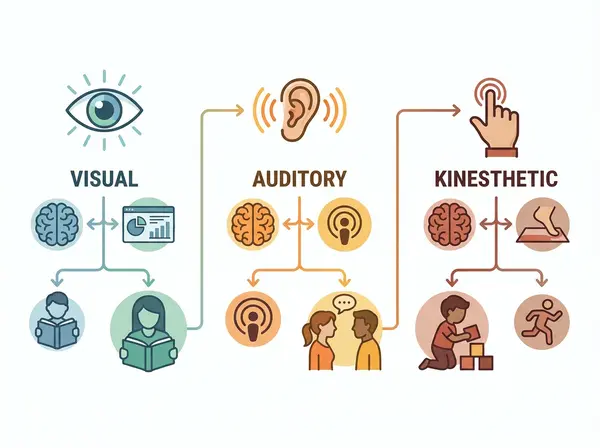
People process information through three primary sensory channels, Visual, Auditory, and Kinesthetic (VAK). When you match their preferred style, your message lands more effectively:
Visual (See, Look, Picture, Imagine, Clear)
"Can you see what I'm describing?"
"Let me paint a picture of what success looks like."
Auditory (Hear, Sounds, Tell, Listen, Resonates)
"Does that sound right to you?"
"I hear what you're saying."
Kinesthetic (Feel, Grasp, Handle, Touch, Solid)
"How does that feel to you?"
"Let's get a handle on this together."
When coaching executives in Everett and Bremerton, I see transformation happen when they stop using only their preferred communication style and start flexing to meet others where they are.
Top 7 Underlying Assumptions That Transform Leadership Communication
Presuppositions are assumptions that, when adopted, create powerful behavioral shifts. Here are the seven I teach every manager:
1. The meaning of your communication is the response you get.If your employee didn't understand, you didn't communicate clearly. Take ownership.
2. People respond to their map of reality, not reality itself.Everyone filters information differently. Understand their perspective before imposing yours.
3. There is no failure, only feedback.Every conversation that doesn't land is information about what to adjust next time.
4. Behind every behavior is a positive intention.Even "difficult" employees are trying to meet a need. Find it.
5. The person with the most flexibility controls the conversation.Rigidity creates resistance. Adaptability creates connection.
6. You cannot NOT communicate.Your silence, your body language, your energy, it all sends a message.
7. If one person can do something, anyone can learn to do it.Excellence in communication is a skill, not a personality trait.
When managers in Bellingham, Lynden and Ferndale internalize these presuppositions, they shift from reactive to strategic. They stop taking employee behavior personally and start addressing root causes with clarity.
Reframing: How to Change the Internal Movie
One of the most powerful science-informed techniques is reframing, helping someone change their internal representation of a situation.
Imagine a manager who's terrified of giving feedback. Inside their mind, they have a vivid mental movie: the employee gets angry, HR gets involved, they get fired. That internal representation creates physiological stress that makes effective communication impossible.
Through reframing, you change the pictures, sounds, and feelings associated with the situation:
Old Frame:"Giving feedback will make them hate me."
New Frame:"Giving feedback is a gift that helps them grow. My job is to support their success."
When you change the frame, you change the emotional response. Suddenly, what felt threatening becomes purposeful.
This technique draws from neuroscience research showing that our brains cannot distinguish between vividly imagined experiences and real ones Journal of Neuroergonomics. When you consciously shift your mental rehearsal, you prime your brain for different outcomes.
The Directives of the Unconscious Mind (What Derails Conversations)
Your unconscious mind operates by specific rules, and when you don't understand them, they sabotage your communication:
Directive 1: The unconscious mind doesn't process negatives.When you say "Don't think about missing the deadline," the brain hears "missing the deadline."
Solution:State what you want, not what you don't want. "Let's focus on hitting the deadline" is far more effective.
Directive 2: The unconscious mind takes things personally.General criticism ("The team isn't performing") gets internalized as personal attack.
Solution:Be specific and separate behavior from identity. "The last two reports had calculation errors" vs. "You're careless."
Directive 3: The unconscious mind needs specificity."Do better" means nothing. "Complete three client calls per day with documented follow-up" creates clarity.
Understanding these directives prevents the most common communication failures I see among leaders throughout Bellingham and the greater Puget Sound area.
Bringing It All Together: A Framework for Every Conversation
Whether you're addressing body odor, navigating conflict, celebrating success, or facilitating a team meeting, use this framework rooted in the Three Pillars:
[IMAGE PLACEMENT 8]Position:Before framework listMidjourney Prompt:Three-pillar architectural structure with labels for Awareness, Listening, Word Choice, professional business setting, metaphorical visualization, modern design, 3:2 aspect ratio --ar 3:2Alt Text:Three Pillars of Communication framework visualization for Seattle area business leadersDimensions:1200x800 (3:2 aspect ratio)
Before the conversation:
Regulate your state (breathing, physiology, intention)
Clarify your desired outcome (specific, measurable)
Review relevant presuppositions
During the conversation:
Observe their state and communication style (VAK)
Listen for needs behind the words
Ask Language Precision Framework questions for specificity
Speak in positive, specific language
Match their sensory preference
After the conversation:
Notice the response you got (feedback, not failure)
Reframe any lingering anxiety
Identify what to adjust for next time
This systematic approach eliminates the overwhelm that keeps managers in Mt. Vernon and Marysville stuck in avoidance. When you have a repeatable process, difficult conversations become manageable.
The Transformation: From Avoidance to Confidence

When leaders master the Three Pillars of Communication, the transformation is profound:
Before:
Avoiding employees
Creating physical and emotional walls
Short-tempered and timid
High turnover and toxic culture
Ineffective leadership
After:
Confident in addressing any issue
Connected and approachable
Calm and clear
Cohesive, motivated teams
Recognized as an effective leader
The managers I coach across the Puget Sound region, from Seattle to Olympia to Bellingham, consistently report the same breakthrough moment: the realization that they were never "bad at communication." They simply didn't have the right framework.
Your Next Step
Leadership communication isn't about scripts or memorized phrases. It's about understanding how messages land, how people process information, and how to create specificity that eliminates confusion.
The Three Pillars, Awareness, Listening, and Word Choice, give you that foundation.
Whether you're preparing for a difficult conversation tomorrow or building long-term leadership presence, these principles provide a roadmap from overwhelm to clarity.
Because the truth is: every leadership problem starts with a conversation gone sideways. And every solution starts with communication that lands.
Want personalized coaching to master the Three Pillars? Schedule a complimentary 30-minute clarity call to discuss your specific leadership communication challenges. Visit Clearly Communicate.
About the Author:
Barbara Jenksis a Strategic Leadership Communication Coach and CEO of Bright Fulcrum, specializing in neuro, cognitive, and behavioral science, neuroscience, and improv techniques. With over 20 years of HR experience across Fortune 500 companies including Boeing and 20th Century Fox, and mid-sized companies like Bellingham Cold Storage (VP of Administration), she helps managers in the Puget Sound region transform communication gaps into clarity, confidence, and results. Barbara is also an equine specialist volunteer with Unbridled Spirit, bringing unique body language expertise to leadership development. Connect with Barbara at Clearly Communicate.
3. FAQ SECTION
Q1: What are the Three Pillars of Communication?
The Three Pillars of Communication are Awareness (understanding your emotional and physiological state), Listening (hearing the need behind what's being said), and Word Choice (using specific language that creates clarity). These pillars form a neuroscience-backed framework for effective leadership communication.
Q2: How can science-informed communication tools help managers in the Puget Sound region improve communication?Neuro, cognitive, and behavioral science provides practical techniques like the Language Precision Framework for developing specificity in word choice, presuppositions, and VAK (visual, auditory, kinesthetic) communication styles that help managers address difficult conversations with confidence. Leaders in Seattle, Bellingham, Whatcom County and Bellevue use these tools to transform workplace communication and reduce costly misunderstandings.
Q3: What is the Language Precision Framework in communication science?
The Language Precision Framework is a linguistic framework that identifies vague language patterns (generalizations, deletions, and distortions) and uses precision questions to create clarity. It helps managers move from general complaints to specific, actionable information.
Q4: How do I prepare my emotional state before a difficult conversation?
Take 60 seconds to regulate your physiology: breathe deeply, release physical tension, and consciously choose your intention for the conversation. Your emotional state is contagious, so entering with calm confidence rather than anxiety dramatically improves outcomes.
Q5: What is VAK communication and why does it matter?
VAK stands for Visual, Auditory, and Kinesthetic, the three primary ways people process information. When you identify and match someone's preferred sensory style, your message lands more effectively because you're speaking their mental language.
Q6: How much does poor communication cost businesses?
Poor workplace communication costs American businesses $1.2 trillion annually, with large companies losing an average of $62 million per year. Beyond financial costs, ineffective communication creates high turnover, toxic cultures, and leadership failures.
Q7: What are underlying assumptions and how do they improve leadership?
underlying assumptions are empowering beliefs like "the meaning of your communication is the response you get" and "there is no failure, only feedback." When managers adopt these perspectives, they shift from defensive to strategic, taking ownership of communication outcomes. Presuppositions are also powerful when speaking to an employee when you are reminding them of good work they've done in the past and how that assures their success in the future, to help the employee feel and see their success. So powerful coming from their manager. Embedding success in the question triggers buy-in before resistance takes hold. It's a small language shift with a big behavior impact. They can also be used to help an employee choose to move in the direction you need them to do. Here's an example of how a manager can move an employee toward being accountable: For example, let's say I'm working with an employee, Caitlyn, who I want to be more accountable. I'll say: "Caitlyn, looking back, what part do you feel was in your control?" This suggests she was in control, and this phrasing nudges her toward accountability. Later in the conversation, I'll ask "When you own this, what's your next move?" This phrasing assumes she's already moving forward and progress is underway. These questions not only assume capability and success, they assume Caitlyn cares. Pay attention: when I ask like Caitlyn cares, she begins to care, becomes connected and feels engaged. Isn't that what leaders want the most?
Q8: Can leadership communication skills be learned, or are they innate?
Leadership communication is absolutely a learnable skill. Using frameworks like the Three Pillars and science-informed techniques, managers who once avoided difficult conversations become confident communicators. Excellence is a process, not a personality trait. And the tools are simple and easy to learn - you can learn and utilize one tool and have better communication, or you can learn multiple tools and use them in any combination of ways to massively impact your ability to connect and persuade.
